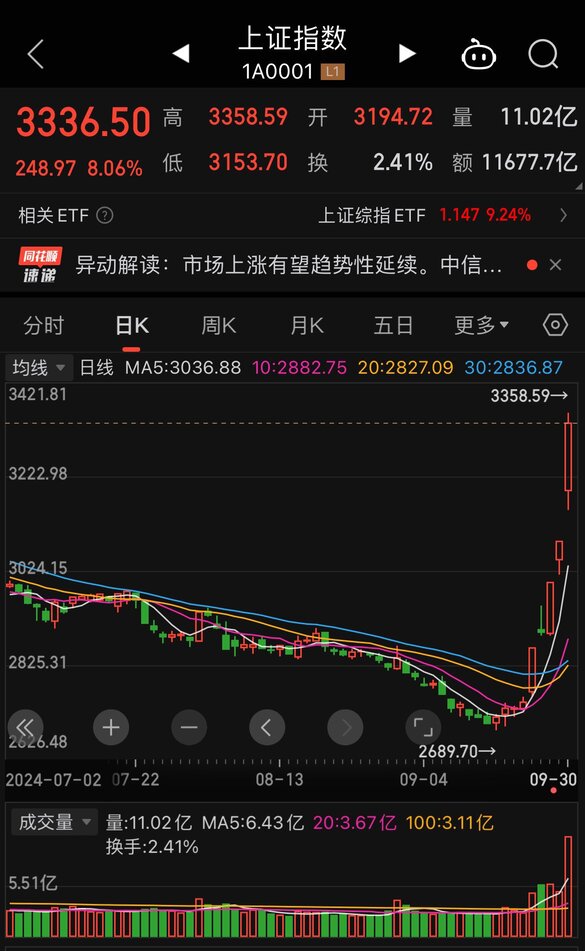
The Shanghai Composite Index surged 8.06% today, breaking the 3300-point mark. Total trading volume across the two markets reached a massive 2.6 trillion yuan, setting a new historical high, with all brokerage stocks hitting the upper limit. Faced with such a fierce surge, many people cannot help but wonder: how long can this frenzy continue? Should we take profits now?
Personally, I believe that this market rally is unlikely to be a flash in the pan; rather, it is a mid-term process that could last for two or three months.
What Exactly Happened in Today’s Market?
Today, the three major A-share indices opened and rose collectively. The Shanghai Composite Index closed up 8.06%, standing above 3300 points; the Shenzhen Component Index rose 10.67%; and the ChiNext Index surged 15.36%. Furthermore, the Northern Securities 50 and STAR 50 indices rose 22.84% and 17.88% respectively, both setting new records for the largest single-day gains. Total trading volume reached 259.3 billion yuan, an increase of over 114.7 billion yuan compared to the previous trading day. Despite a net outflow of 51.7 billion yuan in capital from the overall market, the market displayed a broad-based upward trend—5,336 stocks rose, while only 8 fell, and 713 stocks hit the upper limit, with 2 hitting the lower limit.
The Human Condition in the Market
Throughout the day, I observed the reactions of various market participants, showing a significant polarization between veteran and novice investors.
Many veteran investors remain in a wait-and-see attitude, and few are actively trading. Those who are trading often hold small positions. Their mindset is that this wave of gains is unsustainable, and a sharp crash could happen tomorrow. Therefore, their trading style is quick entry and quick exit—they aim to grab a quick profit and leave.
In contrast, new investors who are experiencing such a massive surge for the first time are generally optimistic, even blindly so. They lack risk awareness; continuous profits make them euphoric, leading them to believe they can make a huge fortune and exit the market unscathed.
Why Is the Market So Frenzied?
First, it must be said that this is the largest single-day gain I have witnessed. The various online groups today have been incredibly lively, with both bulls and bears being highly active. People’s attention toward the stock market has reached a new height. Since the Central Bank announced its personal intervention to purchase financial assets on September 24th:
- Capital Inflow: A large amount of capital, lacking investment targets, poured into the A-share market, directly driving up the market.
- Short Covering: As the market rose at an extremely rapid pace, a large number of short sellers utilizing margin lending were forced to liquidate (covered), further propelling the market upward.
- New Blood: The market has gone 8 years without a period of prosperity, and a new generation of young investors who have never experienced such a boom is now entering the arena.
How Is This Market Rally Different from Previous Ones?
Unlike in the past, I believe this rally has distinct differences from previous cycles:
Direct Central Bank Intervention: This time, the Central Bank is not merely guiding policy; it is personally purchasing financial assets and establishing two structural monetary policy tools: the swap facility for securities, funds, and insurance companies, as well as stock repurchase and increased lending facilities. This scale of capital injection is unprecedented.
Clear Policy Direction: This rally is not simply a case of “cutting leeks” (harvesting small investors); it is aimed at driving the prosperity of financial assets, which in turn pushes sectors like real estate, thereby alleviating downward economic pressure. This goal clearly requires a medium-to-long-term market rise, not just short-term volatility.
What Will the Future Trend Be?
Due to the statutory holiday, the market will be closed for 7 days starting tomorrow. After the holiday, the market may first experience a wave of correction, as many people hope to realize their paper profits. This is human nature—people prefer certain returns and crave the security of having profits “in the bag.”
However, they will find that after this short-term pullback, the market will advance further, driven by the goals of this rally. Those who exited early, having profited, will be distressed by the market’s continuous ascent, having cut off their own gains. Consequently, some will re-enter the market, and they will do so with even larger amounts of capital (just as Newton, the founder of physics, did during the stock market bubble).
Next, the market will enter a state of artificial prosperity. But this prosperity cannot last indefinitely.
- First, the fundamental economic conditions have not improved, nor have personal incomes. Although those holding financial assets have gained returns, the economy of the vast majority of people remains precarious.
- Second, real estate faces immense inventory pressure. With only 8 million newborns this year, real estate cannot truly secure demand.
Ultimately, the artificial prosperity built upon this strong stimulus will gradually cool down.
Conclusion
Behind today’s massive surge in the A-share market, the Central Bank’s direct intervention is undoubtedly the key driving factor, and the varied reactions of different market groups have further amplified the market’s volatility. Although this rally brings significant market prosperity in the short term, from a macroeconomic and structural perspective, this prosperity carries considerable uncertainty. The market may experience a pullback after the holiday, followed by continued ascent driven by policy, potentially entering a state of artificial prosperity. However, the pressure from the economic fundamentals and the real estate market will eventually cause the market heat to cool down.